Showing posts with label Merc Insignia. Show all posts

Schnee's Schneemann


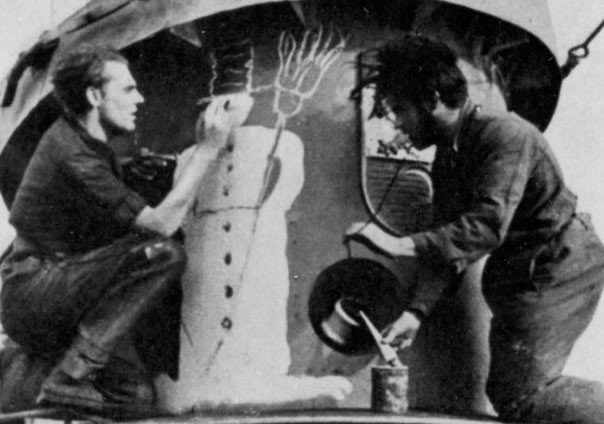
This 'Schneemann' (snowman) was one of a pair that adorned the tower of U-boat 201 along with the crest of the German town of Remscheid.


U-boat 201 became famous while under the command of Kptlt. Adalbert Schnee, who also commanded the U-boats U-6, U-60, U-121 and U-2511, sinking twenty-one merchant ships on twelve patrols. His last name, Schnee, means "snow" in German and thus the snowman was a natural choice of emblem for his vessel. Two versions of the snowmen were painted during U-201's service. When commander Schnee received his Knights Cross in August 1941, the Snowmen of course got one as well.


In the Ma.K universe this snowman was initially the personal insignia of Lt. Giotto Uffizi who was a member of the Mercenary Army's 44th Armoured Huntsman Regiment. The snowman was originally painted on the breastplate of Uffizi's AFS Mk. 2 during 'Operation Sherbet Garden' (the name of the Mercenary's strategy to capture the port city of Arkhangelsk ). When a winter whitewash was applied to the front of the suit during the campaign, the snowman was repainted on the engine compartment.

Lieutenant Uffizi was eventually promoted to Captain of the First Independent Experimental Fireball Company, subsequently his personal snowman insignia, which he had first used during his deployment in Northern Europe with the 44th Armored Huntsman Regiment, became the emblem of the new unit with the addition of a crescent moon.


Figaro


A picture of Wing Commander Ian Richard Gleed in his Spitfire decorated with a cartoon image of 'Figaro' the cat swatting a swastika and palm tree, Tunisia, 1943. Gleed was given the nickname 'Widge' – short for 'Wizard Midget', apparently due to his tendency to call things 'Wizard' (like people today describe things as 'Wicked'), and his short stature (he was 5 feet 6 inches / 1.65m). He mentions his RAF nickname in his part-fiction, part-autobiographical book but claimed not to know how he got it (although that may be irony as his commanding officer calls him 'Widget' on the same page).


Ian Gleed adopted Figaro as his mascot for his brand new Hawker Hurricane, P2798, which he was issued on his arrival at 87 Squadron in France in May that year (although he wrote that the mascot was already painted on, which suggests he had used it before going to France).Figaro shattering a swastika with his paw became the then Flight Lieutenant Gleed's unofficial coat of arms. Wing Commander Gleed used the Figaro badge on all his personal aircraft up to and including the day he died. He saved the original doors decorated with his Figaro emblem from two of his Hurricanes, P2798 and Z3779. A fragment of the Spitfire in which he died, AB502, containing the Figaro, was recovered from the crash site by a childhood friend who was also serving in North Africa at the time. All three were kept by Wing Commander Gleed's family until they donated them to the RAF Museum in 1971.


Figaro was a cartoon cat that first appeared in Walt Disney's animated film, Pinocchio. Although a relatively junior character in the film, he seems to have been featured prominently in some of the film's posters.The film was released in February 1940.


A tribute to Gleed's Figaro appeared on the decal sheet that came with the  Ma.K.Combat Scheme Card File from SF3D To Ma.K. #2, only this time he's sporting an Excimer laser.


Lucky Star


The emblem of the 357th Armored Huntsman Regiment, 3rd company, 2nd platoon.

Bryan Krueger pointed out to me that the insignia is actually the Finnish air force's blue swastika (Hakaristi) with the gaps filled in (makes sense considering that the other Jerry marking was also Finnish in origin). Interestingly the Finnish Hakaristi predates the Nazi Hakenkreuz (Hook Cross), the symbol apparently being a popular good luck talisman for many pilots during the early years of aviation.


Finland became independent after the break-up of the Russian Empire. Blue and white had always been the Finns' national colours so they were chosen for the national flag and the air force's insignia. Count von Rosen of Sweden was very involved with the setting up of the first Finnish Air Force so his personal swastika emblem was used as a wing and fuselage marking in blue on a white disc. This was sometimes painted on the rudder.

"Von Rosen had painted his personal good luck charm on the Thulin Typ D aircraft. This charm – a blue swastika, the ancient symbol of good luck – was adopted as the insignia of the Finnish Air Force. The white circular background was created when the Finns tried to paint over the advertisement from the Thulin air academy. The swastika was officially taken into use after an order by Mannerheim on 18 March 1918. The FAF had to change the insignia after 1945, due to an Allied Control Commission decree, where the swastika had to be abandoned due to the association with the nazism."


The forces of the U.S.S.R. invaded Finland in 1939. With the German invasion of Russia in 1941, Finland threw in her lot with Germany. The country was forced to sign a peace treaty with the U.S.S.R. in 1944 and to declare war on Germany. A swastika marking was obviously inappropriate, so a white, blue, white roundel was adopted.


The swastika (from Sanskrit svástika) is an equilateral cross with its arms bent at right angles, in either right-facing (卐) form or its mirrored left-facing (卍) form. Archaeological evidence of swastika-shaped ornaments dates from the Neolithic period and was first found in the Indus Valley Civilization of the Indian Subcontinent. It occurs today in the modern day culture of India, sometimes as a geometrical motif and sometimes as a religious symbol; it remains widely used in Eastern and Dharmic religions such as Hinduism, Buddhism and Jainism.


In the Western world, the symbol experienced a resurgence following the archaeological work in the late 19th century of Heinrich Schliemann, who discovered the symbol in the site of ancient Troy and associated it with the ancient migrations of Proto-Indo-Europeans. He connected it with similar shapes found on ancient pots in Germany, and theorized that the swastika was a "significant religious symbol of our remote ancestors", linking Germanic, Greek and Indo-Iranian cultures. By the early 20th century, it was used worldwide and was regarded as a symbol of good luck and success as evident in the above 1920's American postcard. Despite this usage, the symbol has become stigmatized and to some extent taboo in the Western world because of its iconic co-option by Nazi Germany.


Supersonic Lynx, Farting Moose


The 'Wildcat' was one of the company insignia used by the 44th Armored Huntsman Regiment.

"This Jerry was painted for service in Northern Europe, summer 2885. 8 were sent to the 44th Armored Huntsman Regiment but one was lost and only 7 arrived. These went into battle immediately and, thanks to the heavy armor, even when hit didn't suffer any damage and managed their first kills on just the 2nd day after they were received. Unit emlem was the Wildcat and number was placed on the rear of the body instead of on the side as were the kill tallies."

The emblem is actually the 'Supersonic Lynx' of Finland's Lentolaivue 24 ...


Finland's premier fighter squadron during World War 2, Lentolaivue 24 (Flying Squadron 24) first saw action during the bloody Winter War of 1939-40, when the Soviet Red Army launched a surprise attack on the small Scandinavian country - the squadron enjoyed great success against numerically superior opposition. LLv 24 was once again in the thick of the action following the outbreak of the Continuation War in June 1941. Easily the air force's most successful fighter unit, LLv 24 claimed 877 kills, and its pilots won five direct and two indirect Mannerheim Crosses (Finland1s highest military award) out of a total of 19 presented to all Finnish soldiers. Most top aces also scored the bulk of their kills flying with this unit.

"No. 24 Squadron (Finnish: Lentolaivue 24 or LLv.24, from 3 May, 1942 Le. Lv.24), renamed No. 24 Fighter Squadron (Finnish: Hävittäjälentolaivue 24 or HLe.Lv.24 on 14 February 1944) was a fighter squadron of the Finnish Air Force during WWII. The squadron was part of Flying Regiment 2.
During the Winter War, all Fokker D.XXIs - Finland's only modern fighter - were concentrated into the No. 24 Sqn, making it the only frontline fighter force.
No. 24 Squadron was the most successful fighter squadron of the Finnish Air Force during World War II, claiming 877 aerial victories for a loss of 55 aircraft. The unit produced seven Mannerheim Cross winners, including Ilmari Juutilainen and Hans Wind, the two top-scoring aces.
After the re-organization of the Finnish Air Force after WWII, HLeLv 24 was renamed into HLeLv 31. Today it is part of the Karelian Wing, flying F-18 Hornets and still sporting the "Supersonic Lynx" as its emblem."


A picture of the only surviving Brewster Buffalo fighter aircraft. The Finnish Air Force Brewster model 239 fighter BW-372 crashed in a lake in Sekee, Karelia (now part of Russia) during WW2 and was found and recovered in 1998. The former US Navy plane is now in the National Museum of Naval Aviation in Pensacola, US.

"A Finnish Air Force Brewster BW-239 piloted by lieutenant Lauri Pekuri on a reconnaissance task behind enemy lines. Pekuri soon confronted enemy planes, four Hurricane fighters. In the ensuing dogfight he shot down one Hurricane, but was himself hit in the engine which started to burn. Trailing black smoke he turned west towards his home base. Pekuri soon realised he had to find a place to make an emergency landing. The only open spot in the forest-covered landscape was a lake, toward which he steered.
A roaring engine and a shadow above Pekuri's plane. One of the enemy Hurricanes zoomed past with surplus speed from its dive. The underside of the enemy plane suddenly fills the Brewster's sights. Pekuri fires a series against the Hurricane which folds and crashes in the forest. The Brewster pilot steers toward the lake for a belly landing. The plane flips on its back, becomes filled with water and sinks. Pekuri extricates himself from the wreckage, having reached the surface he kicks off his boots and swims to shore. Then he penetrates 15 miles on foot through the wilderness to the Finnish lines."

A more detailed account of Lauri Pekuri's miraculous escape can be read here.

Above is the 'Farting Moose' emblem of 2/Le. Lv.24, almost destroyed after being submerged in a Russian lake for more than half a century.

Archelon - 'Ruler Turtle'


It's little wonder that the AFS Archelon decal sheet includes turtle markings as the suit was named after the largest of all sea turtles known to have existed ... the colossal ARCHELON ISCHYROS (Greek - 'Ruler Turtle'), specimens of which have been discovered measuring up to 4 meters long and nearly 5 meters wide!


Trouble With Jolanthe


This little piggy first made an appearance on the SF3D era Raccoon decal sheets/camo cards as the insignia for the 30th SAFS Company. It later resurfaced as a graphic on the packaging of the Ma.K generation re-release of the same kit (quite apt as the profile of the Raccoon looks conspicuously porcine). In 2001 the pig was included on the decal sheet of the Modelkasten Snake Eye as the emblem of the 51st Combat Recce Company, 2nd Platoon. More recently the marking has made it's way on to the new Wave Snake Eye decals ...


The 'Jolanthe Kette', or 'Jolanthe Squadron', was the nickname given to the first three Stukas sent to Spain as part of Germany's secret military involvement in the Spanish Civil War. The three Stukas became known as the 'Jolanthe Squadron' most likely because the Ju 87's ungainly appearance as it taxied over rough air strips was reminiscent of the central character of a popular german cartoon film 'Trouble with Jolanthe' ...

"... they were officially incorporated into the Legion as the fighter wing's fifth staffel (5.J/88), but became universally known as the 'Jolanthe' Kette after their unit badge. This depicted a large pink sow, and could trace it's origins back to Barth, where the Gruppenkomandeur of IV.(St)/LG 1, Oberstleutnant Gunther Schwartzkopff (one of the few supporters of the Stuka concept) had nicknamed the Ju 87 after the eponymous heroine of a favorite film comedy of the day that centered around a pig 'Krach um Jolanthe' ('Trouble with Jolanthe')!"


"The popular German stage play Krach um Jolanthe was brought to the screen by producer-director Carl Froelich in 1935. Jolanthe is the name of a prize sow, the pride of a tiny rural community. Trouble begins when the sheriff comes calling, demanding to collect an exorbitant tax on the blue-ribbon oinker. When the owner can't pay up, the sheriff holds an auction to sell the sow to the highest bidder. The loyal townsfolk boycott the event, then plot a "jailbreak" when the sow is placed in custody of the local constabulary. Subtlety is hardly the strong suit of Krach um Jolanthe; the audience is invited to park its dignity at the door and laugh out loud unashamedly." ~ Hal Erickson, All Movie Guide


All Hail The Rat


The egg with hatchet and pistol is probably the most iconic of the Mercenary army's unit insignias. It was originally released as one of the decal options for the Nitto S.A.F.S. and has recently been re-released by Hasegawa on the new decal sheet included with their 'Ma.K figure set A (Mercenary Troops' Arms Cold District Maintenance Soldiers)'. According to notes on the cards that came with the figure set, the markings belong to the 15th AT regiment.


I believe that the 'egg' symbol is a pastiche of the emblems of two Luftwaffe Aces, Adolf "Dolfo" Joseph Ferdinand Galland and Lieutenant Colonel Oskar-Heinz (Heinrich) "Pritzl" Bär. Both men (who were apparently good friends) had variations of 'Micky Maus' painted on their planes and the 'egg' seems to borrow elements from both. Clearly the hatchet, pistol and pose come from Galland's ...


"Adolf was a constant cigar smoker. In fact the insignia on his Messerschmitt depicted a cigar smoking Mickey Maus also brandishing a pistol and hatchet! It was said that Galland got through 20 cigars a day and actually wrote orders giving him permission to smoke while flying on a mission. His was the only Messerscmitt with a cigar lighter and a cigar holder for when he was on oxygen."


... while the red circle was likely inspired by the blue one around Heinrich's Maus (which was also the unit symbol of 1./JG 51)


The origin of both 'Mickys' goes back as far as the Spanish Civil War (of which Galland was a veteran), as can be seen in this picture of Condor Legion pilot Hans Schhmoller-Haldy ...

"The 8th Staffel’s Oblt. Edu Neumann, inspired by the popularity of Mickey Mouse among the Condor Legion veterans, adopted another cartoon character as a symbol for his then 4th Staffel and took it with him to the 8th. He made it known that his choice, Adamson, was a good German rather than an American."

It appears that 'Steamboat Willie' had enjoyed a long history with the Luft even before the war ...


Above is another example of a Condor Legion 'Micky'.


Luftwaffe Ace Horst Carganico also famously displayed a 'Micky Maus' on his Bf. 109G-6 ... another of many examples of the nefarious rodent's ever changing allegiances during the war.
Mickey Mouse ... a true mercenary!


Pardon My French


The 'archer' symbol from the Wave AFS decal sheet is based on the markings of 1. Escadrille 'Archers', Groupe de Chasse I/1, Escuadron de Chasse 1 of l'Armée de l'Air française (the French air force) ... as can be seen here and here.


'The Green Ghosts'


The RAAF had their own unique variant of the Beaufighter. It was built by the Department of Aircraft Production and was referred to as the DAP Beaufighter or Mk.21. The DAP variant was given new engines, a tail-plane with dihedral and enhanced armour. These aircraft were used as an attack/torpedo bomber. Australian production ended in 1946 but not before 365 Mk 21s had been built. Because of its quiet engines and heavy firepower the Japanese referred to the Beaufighter as “Whispering Death”.


These aircraft markings are from 'Green Ghost 2' ... one of the Beaufighters that flew with No. 93 Squadron RAAF. The marking of the bee/wasp wearing a top hat and riding a rocket was included on the decal sheet that came with the recent Ma.K Falke profile.

The 93rd Squadron was formed on January 22 1945 without an official name or motto. So unofficially it was known as the “Green Ghost Squadron” and the unofficial motto was “Spookus Sneakinus”. Mid 1945 they transferred to an island off Borneo called Labuan. Their task was to disrupt Japanese shipping and airfields. In August 1945 the squadron was tasked with destroying a Japanese oil tanker. The ship was destroyed but turned out to be the 800 ton private yacht of the Rajah of Sarawak. The 93rd Squadron was disbanded on 22 August 1946.

No 93 Squadron

"After forming at Kingaroy, Queensland in January 1945, No 93 Squadron'sBeaufighters deployed to Labuan, Borneo in July. Referred to as the 'Green Ghost Squadron', the Squadron's first mission was flown on 26 July when two aircraft flew an armed reconnaissance over Borneo.
Five days later, rocket armed Beaufighters attacked a barge carrying Japanese soldiers accompanied by a vessel identified as a Japanese oil tanker. Eighteen hits were recorded on the 800-ton tanker, which was later reported to have sunk. Operations in the month following Japan's surrender saw the Beaufighters dropping leaflets over Japanese areas advising the isolated units that the war was over. The following months, No 93 Squadron Beaufighters provided navigation escorts to formations of RAAF single-engine fighters returning to Australia or proceeding to Japan on occupation duties.

Returning to Australia in 1946, No 93 Squadron was disbanded at Narromine New South Wales on 22 August 1946."

More about the squadron history here ...


'The Polar Bear Butchers'


Noticed a discounted book in the local coffee shop this morning ... the title grabbed my attention "The Polar Bears - Monty's Left Flank". The blurb reads ...


"With its roots in the West Riding of Yorkshire, the 49th Infantry Division was originally a territorial unit formed in 1907 which fought with distinction throughout World War I earning three VCs. During 1940-42 it fought in the ill-fated campaign in Normandy, garrisoned Iceland for two years and earned itself the title of the Polar Bears. In the north west Europe campaign of 1944-45 it acted as Monty's left flank and suffered 11,000 casualties in 11 months. After the battle for Normandy, the Polar Bears took a major role in the capture of Le Havre, campaigned vigorously in Belgium, helped to take Arnhem and then liberated Utrech and Hilversum. In the last weeks of the war, the Polar Bears brought food supplies into starving Holland. This is an illustrated account of their exploits, based on first hand accounts of the men who actually fought with the Polar Bears."

Curious if there was a Ma.K connection, I did a little web hunting and found out more about the unit history. Apparently they were dubbed the Polar Bears by a Nazi propaganda broadcaster ...


I wonder if the AFS Polar Bear took it's name from this unit and if the insignia inspired the Wave Polar Bear decals?