Showing posts with label Strahl Insignia. Show all posts

Hat Of Glass


Below a Krote featuring the insignia of the 367th Assault Recce Company - a 'Zylinder Hut' or 'Top Hat' on a white disk.


"One of the devices employed by the 367th Assault Reconnaissance Company, which despite being the company to have been issued with the fewest, had the most combat success with the Krote. Each of the 4 Krotes in the company could easily defeat any of the three enemy units in service at the time, the AFS MKI, MKII or J-40."


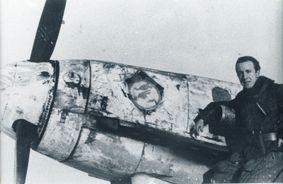
While this particular Top hat motif was the staffel insignia of 2./JG 77, zylinder hut emblems had been popular with the luftwaffe since the Spanish Civil War originating with the Condor Legion fighter wing J/88. Possibly chosen as a symbol of the elite officer class, the top hat was ironically to become associated with the enemy.


This He 51 is one of the batch received by the Condor Legion in October 1936 and wears the first badge of 4.J/88, the Zylinder Hut (Top Hat), that would later be adopted by 2.J/88.


"The emblem that was painted on the first Messerschmitt was the one that had already been used by 2.J/88 on the very old Heinkel, that is to say, the 'Zylinder Hut'. The first major military action of 2.J/88 'Zylinder Hut' (Hat of Glass), with the emblem painted on the backs of its new mount, the Messerschmitt Bf-109B- 1, took place during the course of the Battle of Brunete in July 1937. The base chosen to welcome in 2.J/88 of the Condor legion was Avila, its mission to escort and to protect the Junkers Ju-52/3m bombers, but the inevitable cruelty and ferocity shown by both sides during 'hunting' became immediately apparent. However, from the 8th of July the National Side had dominion of the skies due to the action of the Legion Condor and in particular to the Messerschmitt of the 'Zylinder Hut'."


The Zylinderhut was adopted as a personal insignia by a number of pilots who had seen service with the Condor Legion in Spain. Major Handrick who had been Kommandeur of Jagdgruppe 88 continued to use the top hat emblem when he took command of JG 26. Another JG 26 pilot to display this emblem was Hptm Herwig Knüppel.

"The Legion Condor 'Zylinder Hut' given to its popularity between the German pilots was present on a multitude of fuselages of the Germanic airplanes during World War II. Lt. Hubert Kroeck of the Jagdgeswader 53 'Pik Ace' used the 'Zylinder Hut' of 2.J/88 as a personal emblem. Curiously the 'Hat of Glass' that was painted on the fuselage of his Messerschmitt was white and not black as was typical in 2.J/88 of the Legion Condor. Like Kroeck, another member of 2.J/88 'Zylinder Hut', Oblt. Herbert Ihlefeld also used the 'Hat of Glass' as a personal emblem, at least during the course of Battle of England in which he was Gruppenkomandeur of I. (j) LG 2. Oblt. Herbert Ihlefeld survived World War II and reached a total of 132 victories. Oblt. Reinhard Seiler, “Ace” in Spain and member of 2.J/88 'Zylinder Hut', also used the 'Hat of Glass' as his personal insignia during World War II. Oblt. Seiler served with Jagdgeswader 54 'Grünherz' fighting on the Russian Front and survived the end of war with 109 victories. Finally, another veteran of the Legion Condor in Spain, the Fw. Alfred Held, who flew with 4.J/88 'Pik Ace', also used the 'Hat of Glass' like a personal emblem, adorned by a legend that said “Kolle alaaf”. By the 4th of September 1940 Alfred Held had the singular honor of being the first Luftwaffe commander to have destroyed an airplane of the R.A.F."


The Worm That Turned


"Even after other companies were equipped with the Neuspotter, the 402nd Armored Hunting Soldier Regiment continued to utilize the Krote. The 402nd's Krote were used for a long period after other company's reserves of Neuspotters were completely depleted. During that time, the Krote were fitted with stationery weapons and defeated many enemy AFS's."


Under The Thumb


Below, a Krote of the 501st Independent Heavy Battle Car Battalion. The battalion insignia depicts a 'Zylinderhut' or 'Top Hat' being crushed under thumb.


"One of the 16 Krote's for the 501st Independent Heavy Tank Battalion that was able to handle the work until the critical modifications for the Neuspotter were completed in September 2885. The paint was very basic with green two-toned Splinter camouflage that was never repainted so it was damaged and faded."


The emblem was the staffel insignia of 7./JG 2.

"at its peak in popularity a reaction developed against the top hat, with the middle classes adopting bowler hats and soft felt hats such as fedoras, which were more convenient for city life, as well as being suitable for mass production. In comparison, a top hat needed to be handmade by a skilled hatter, with few young people willing to take up what was obviously a dying trade. The top hat became associated with the upper class, becoming a target for satirists and social critics. It was particularly used as a symbol of capitalism in cartoons in socialist and communist media, long after the headgear had been abandoned by those satirised.It was a part of the dress of Uncle Sam and used as a symbol of US monopoly power. By the end of World War I it had become a rarity in everyday life, though it continued to be worn daily for formal wear, such as in London various positions in the Bank of England and City stockbroking, or boys at public schools."


While the Zylinderhut motif may have been an attack on the U.S. personified as 'Uncle Sam' who's top hat had come to represent capitalism and a new enemy to the Luftwaffe, it may also have been a defiant stance against the British aristocracy, and in particular the Prime Minister Neville Chamberlain.


Caricature of Neville Chamberlain, British Prime Minister at the outbreak of the Second World War wearing a top hat. Chamberlain was gravely concerned about the disastrous effects of leading Britain into another major European conflagration. He became the architect of the ‘appeasement' policy, attempting to avoid war.
Discredited by the failure of his policies and by his belief that Herr Hitler was a man of honour and integrity, Chamberlain was forced to resign in May 1940. He died in the November of the same year.


Desert Viper


Two units with similar snake motifs receive special mention on the Hornisse and PKA H1 camo cards ...


"Gear for Private Oswald Lenpge, of the 12th Armored Hunting Soldier Regiment 5th Company. This was used to defeat 2 AFS during the North American combat. It shows the snake that was the personal symbol of this private. (This later became the symbol of the platoon) It was learned that this private had committed a crime prior to enlisting but this went unnoticed in the activities of the regiment. Since it would have resulted in a military discharge and arrest, the private was desperate. At night, the private sprayed paint across the majority of the canopy, 2 places in the front and one place on each side, leaving a narrow transparent slit. Afterwards, the G model and G-night combat model were modified to this and he was kept active as well as promoted."


"Gear for the 114th Combat Air Force (JG 114) that was spread across North Africa in the subterranean lakes. The basic color was a sandy yellow~desert pink with green gray Splinter camouflage to combine the sandy region spotted with oasis. These units were typically equipped with a ventilation system that filtered sand."


Clearly both insignia are an homage to the mysterious 'Desert Viper' of 6/StG 2. Camouflage was obviously of secondary importance when this extraordinary paint job - producing undoubtedly the most colorful of all desert Stukas - was undertaken. Such a snake motif adorned at least two different aircraft, but whether they were both flown by the same pilot - Lt. Hubert Polz - or were a short-lived staffel (or even Kette) decoration is unknown.

"Hubert Polz's snake-marked Ju 87 is arguably the ultimate example of World War II German nose-art. Despite all the popularity this Ju 87R-2/trop is somewhat mysterious. It is even not sure if this very Stuka was his personal mount.
Probably during a certain period of time around July 1942 the entire flight of 6/StG 2 bore the snake emblem. It is still not established with any degree of certainty if the snake was white-and-red or white-and-sand. Analyzing surviving photos it is less likely that the snake was formed out of white outlines only"


The Cat and The Moon


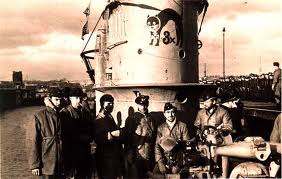
This emblem seems to have originated on the famous U-48 but then later it was also used on many other U-boats as officers from U-48 moved on to new commissions. U-564 also carried the famous 'three black cat' motif of Teddy Suhren who, along with Prien and Kretschmer, was one of the top U-Boat commanders during the battle of the Atlantic.


"U-48 or Unterseeboot 48 was a German Type VIIB submarine of the Kriegsmarine during World War II. U-48 was the most successful U-boat commissioned into the Kriegsmarine during the World War II. During her two years of active service, U-48 sank 55 ships for 321,000 tons, and damaged two more at 12,000 tons on twelve war patrols conducted during the opening stages of the Second Battle of the Atlantic. She was a Type VIIB submarine with five torpedo tubes and an 88 mm deck gun. She was very fast and agile, thanks to her dual rudders, and could patrol for approximately a month at a time, giving her a range comfortably across the North Atlantic."


A Dog's Life


Bonzo the dog was a fictional character (a chubby little white pup with sparse spots, a stubby tail and big blue eyes) created by British artist George E. Studdy in the early 1920's.


"Bonzo became the inspiration for much commercial merchandise, such as cuddly and mechanical toys, ashtrays, pincushions, trinket boxes, car mascots, jigsaw puzzles, books, calendars, candies, and a profusion of postcards.
Bonzo, wearing a set of headphones, became associated with the "Crosley Pup", an affordable mass-produced AM radio introduced by Powel Crosley Jr. in the United States in 1925. Years later, both Bonzo commercial items and Crosley Pup radios became valuable as collectibles. A paper mâché Crosley Bonzo is on display at the Smithsonian Institution in Washington, D.C."


So what's the Ma.k connection you ask? I'm getting to it ...
Just as they had borrowed America's Mickey Mouse, the Luftwaffe also chose to adorn their aircraft with Britain's Bonzo the Dog who became the staffel insignia for I./JG 2.


So finally we come full circle ... Bonzo (as he was depicted by I./JG2) was included on the 1/6 Nitto Melusine decal sheet as the insignia for the 7th Armour Hunting Soldier Battalion, 1st company, 3rd Platoon.  


"7th Armored Hunting Soldier (Army) Battalion 1st Company 3rd Platoon "Fighting Dog" Unit. The unit was unprepared for the New Zealand combat and suffered many casualties but for 8 months after the end of the war, they continued occupying this same territory. The diagram shows the camouflage from winter to early summer."

... Bonzo appeared again on the decal sheets of both Modelkasten Melusine releases.


The U-Boat Connection


This long armed froggy was originally included on the Nitto Konrad decal sheet as the insignia for 2./JG 26 and then later also appeared on the Oskar and Lunar Konigs Krote decals as well.


Interestingly this is not a luftwaffe insignia but instead a Kriegsmarine U-boat emblem. In fact it is the unique symbol applied to U-124 by Kptit. Jochen Mohr when he took command of the vessel ...

"The emblem of U-124, the Edelweiss, was inspired by the loss of U-64 in April, 1940. The boats had the same crew for the most part, including the commander Kptlt. Wilhelm Schulz. They were saved from the cold Norwegian waters by members of the German mountain troops. The grateful U-boat men adapted their emblem on their next U-boat, the U-124 commissioned in June, 1940.
When Kptlt. Johann Mohr took command of U-124, in late 1941, he added his own personnal emblem, a green frog, to the front of the tower. Keeping the Edelweiss on both sides."

It is possible to just make out the frog insignia on the tower of the U-Boat in the pictures below ...


Dead Eye Open


This marking appeared on the Nutrocker decal sheet as the insignia of the 500th Independent Heavy Battle Car Battalion.


"The 500th Battlewagon Batallion, 1st through 3rd division were deployed from the Middle East extending through North Africa. When on maneuvers in the desert, all vehicles were painted with a dessert pink. The dry, sandy environment caused many problems for the NutRocker hover tank, with sand frequently being sucked into the turbines. Advanced filters were attached to the air intakes of some tanks to solve the problem. Peeling paint was also very common and noticeable on the tanks because of abrasion from the sand."

The emblem was actually the Holzauge ('Wood Eye') insignia of 1.J/88. Jagdgruppe 88 (J/88) was a German Condor Legion fighter group serving in the Spanish Civil War.


"The colors chosen for this emblem were already the habitual ones used by the Legion Condor in the majority of the standards that represented their Staffel, that is to say white and black. The image of 'Holzauge' appeared on a white disk trimmed by a black circle, located on both sides of the fuselage under the cockpit of the Messerschmitt Bf-109. From the 2nd of September 1938 and to the end of the war in April of 1939 the pilots of 1.J/88 'Holzauge' had several “mounts”. The Messerschmitt Bf-109 B was replaced on 17th of November 1938 and with that the Staffel accomplished missions on the Catalonia front from the aerodrome at Cenia. After occupation of Catalonia the Staffel received the new Messerschmitt Bf-109E “Emil”, that featured great advances such as the incorporation of a radio and oxygen masks. Like its predecessor the “Hababuk”, the image of “Holzauge” was not used by the Luftwaffe during the Second War World."

The 'Wood Eye' (English equivalent - 'Dead Eye') represents an expert marksman.

“The first Staffel has a Holzauge. Wood Eye -- what the Americans would call a dead eye. He was a cartoon figure, his eyes peeled skyward."


"The new emblem of 1.J/88 presented/displayed the image of a peculiar clown registered inside a white circle. This figure appears to be pointing at its eye while at the same time it glances at the sky. The name of this figure, which at that time would have been the indicative name of the Staffel, was 'Holzauge', that is to say 'wood Eye'. 'Holzauge 19' was the code name that was used by the Luftwaffe to designate an airplane or airplanes whose main mission was to watch the formation, warning others of the presence of the enemy and entering into combat with them so that their comrades could continue with their mission. As well, the Germans also called the adversary who undertook the same mission “Holzauge”. The gesture shown in the emblem corresponds nevertheless to a typical Spanish gesture, to put oneself on guard when danger is present by placing the forefinger on the eye."


The Early Bird Gets the ... er ... Umbrella?


The last of the PKA HO unit emblems ... this time for the 2nd Heavy Artillery Battalion HQ.


"This PKA HO was deployed to Northern Ireland in November 2885 and was operated by Second Lieutenant Heintz Zakusenberk of the 2nd Heavy Artillery Battalion HQ. Heintz was tasked with the high altitude support of the 'Night Stalker'. The son of a leatherworker, he was considered odd due to the habit of going barefoot even during winter."

The emblem was really the 'weeping raven' of II./JG 51 designed by Luftwaffe pilot Hans Illner. Although Hans' nephew suggests the bird may have been a representation of Winston Churchill, it is more likely that it was a caricature of British Prime Minister Neville Chamberlain as the emblem had existed before Churchill had been voted to power and Chamberlain was often referred to as the 'umbrella man' by the press. Emblazoned on the shield in red writing is the belligerent catchphrase "Gott Strafe England" ... "May God punish England".


'Escuadron Azul' (The Blue Squadron)


In the Ma.K universe this was the emblem of the 343rd Ground Support Platoon which utilized the PKA HO and PK41 in the Australian Desert in May, 2886.

"This platoon was used very often on operations but had almost no losses, with a very high percentage of it's pilots returning from their missions. But when the new high performance Falke arrived, many were captured."


In fact the unit ID has it's origins in the Spanish Civil War as the emblem of Garcia Morato's squadron 'Patrulla Azul' and was later used by 15. (Spanische) Staffel / 'Escuadron Azul' of JG 51 formed from a group of Spanish volunteers June 21, 1942 (though variations of this emblem were used by all of the Spanish Squadrons).


"By June it was clear that preparations for the Wehrmact's 1942 summer offensive in the east were all but complete. But the only material reinforcement for JG 51 came in the unexpected form of a staffel of Spanish volunteers. This was the second such volunteer unit that Spain's Generalissimo Franco had sent to Russia, the first having served originally under JG 27 during the winter of 1941- 42.
Attached operationally to II. Gruppe, the newcomers' official title was 15.(span)/JG 51, but Major Julio Salvador's unit was more usually referred to within the Geschwader simply as the "spanische Staffel" - the spaniards themselves preferred 2a Escuadrilla Azul (2nd Blue Squadron). Whatever their nomenclature, the Spaniards would fight alongside the pilots of JG 51 on the Moscow front throughout the coming summer and winter months"

The birds in the insignia are flying in the "Kette"- formation. This formation, consisting of three planes flying in a 'V', was used by all airforces at the time for ground attacks. The formation was invented by deputy squadron leader, Captain Muñoz Giménez. The motto "Vista Suerte Y Al Toro" translates as : A Glance, Luck, and at the Bull.


"During World War II, one air section, the "Blue Squadron" (Escuadrilla Azul),operated alongside the Blue Division (Division Azul). The Blue Division was a Spanish volunteer group which fought alongside the Axis Powers on the Eastern Front."

A couple of examples of 'Blue Squadron' aircraft here and here.